http://my.spill.com/profiles/blogs/russell-crowe-as-robin-hood

Monday, November 22, 2010

Bulls-eye!

http://www.icons.org.uk/theicons/collection/robin-hood
       When people first think of Robin Hood, they typically imagine a man in green tights shooting a longbow. His legendary marksmanship makes him perhaps the most famous archer of all time whether he really existed or not. The most noted moment of his alleged career was when he split another archer's arrow at an extremely long distance to win the Nottingham tournament. Howard Hill, the man who did the shooting for the 1938 film, proved that such incredible shooting as is talked about in stories and depicted in various films is possible. The arrow splitting moment was beautifully portrayed thanks to his and the actor (Errol Flynn) who played Robin Hood (The Adventures of Robin Hood). This man's skill was amazing. He was by far the most amazing archer on record of all time. According to Howard Hill Archery Company, he won 196 field archery tournaments in a row (The Legend's Story). Depicted here is Howard Hill drawing
http://123nonstop.com/biography/Hill,_Howard_%28I%29


his bow with Errol Flynn next to him watching his technique. 
      Over the past few weeks, several aspects of the Robin Hood legend have been explored. His compassion for the poor, his loyalty to his friends, his romantic attachment, and his remarkable skill with the long bow have all been discussed. In my mind, and I hope in the mind of my readers, Robin Hood definitely made a bulls-eye in the target of life.

Works Cited


The Adventures of Robin Hood. Dir. Michael Curitz, William Keighley. Perf. Errol Flynn, Olivia de Havilland, Basil Rathbone. 1938. Turner Entertainment Co. and MGM/UA Home Video. 1989.
 
"The Legend's Story." Howard Hill Archery. 15 July 2008. Web. 24 November 2010. <http://www.howardhillarchery.com/the-legends-story.html>.

Sunday, November 21, 2010

His Right Hand Man

http://www.robinhoodadventures.com/wp-content/uploads/2008/11/robin_hood_and_little_john_by_louis_rhead_1912.png
       Every hero needs a faithful friend and companion. In the case of Robin Hood, his closest friend was a giant of a man nicknamed "Little John." From close to the very beginning of his outlaw career, Robin and Little John worked in unison through many an adventure. It is said that on the day of his death, Robin's sole companion was the steadfast Little John. An example of their mutual brotherly love is shown when John wants to put himself in danger by going to the Nottingham fair: '"It is much against my will," said Robin Hood, "ne'ertheless, if thou dost wish it, get the gone, but bear thyself seemingly, Little John, for thou art mine own right-hand man and I could ill bear to have harm befall thee"' (Pyle 136). Also shown in this adventure is Little John's bold and impetuous spirit. Always ready for a fight, he loves nothing better than to participate in rough sports. In fact, in one version of the story, when Robin Hood and Little John met they engaged in a quarter staff fight which ended in Hood being knocked into the water. (The Adventures of Robin Hood). All in all, these two men were the definition of two buddies having the time of their lives.


Works Cited

The Adventures of Robin Hood. Dir. Michael Curitz, William Keighley. Perf. Errol Flynn, Olivia de Havilland, Basil Rathbone. 1938. Turner Entertainment Co. and MGM/UA Home Video. 1989.


Pyle, Howard. The Merry Adventures of Robin Hood. Garden City, New York: Junior Deluxe Editions, (Year Not Shown). Print.

Saturday, November 13, 2010

The Love of His Life

http://www.errolflynn.net/Filmography/rh.htm
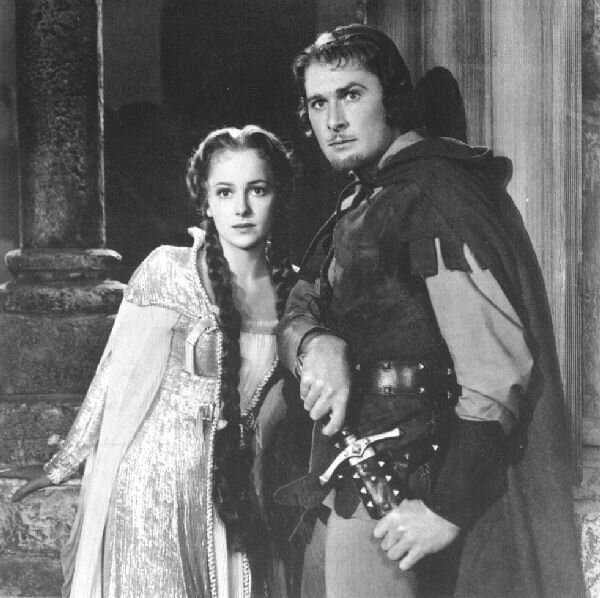
      Many a tale has been written about the lovely Maid Marian Fitzwalter. A book about her written by Thomas love Peacock in 1818 maintains that her "real name" is Matilda. (Peacock). A few things remain the same no matter which story is read. She is a beautiful woman born of nobles who is desperately in love with the outlaw Robin Hood and must hide either her feelings or herself. In several versions, she and Robin are said to have played together as children but circumstances draw them away until they meet again as mature adults and their regard for one another deepens into a strong romance. In a Robin Hood book by J. Walter McSpadden, we read that Marian finally flees her estate when Prince John threatens to take all of her lands if she continues to refuse to marry him. Instead of spending a life full of luxury with a buffoon such as this monarch, she decides to flee dressed as a page to the forest where Robin lives. At this point he makes a stirring statement: "'By this sword which Queen Eleanor game me' he said impetuously; 'and which was devoted to the service of all womankind, I take oath that Prince John and all his armies shall not harm you!" (McSpadden 131). Thus, Marian takes up her permanent residence with her beloved outlaw in his forest.

Works Cited

McSpadden, J. Walter. Robin Hood. Forgotten Books, 2008. Print.

Peacock, Thomas Love. Maid Marian. 1822. Print.

Saturday, November 6, 2010

A Soft Heart Exhibited

      “Alas! for, though Robin Hood and his band may be outlaws, yet he taketh only from the rich and the strong and the dishonest man, while there is not a poor widow nor a peasant with many children, nigh to Sherwood, but has barley-flour enough all the year long through him” (Pyle). Probably the most famous quality of Robin Hood’s is his generous heart to the poor and oppressed. Every story about him dwells on this aspect of his character. The Journal of American Folklore tells us that “Like most outlaws of folklore, Robin Hood is viewed as the champion of the socially and economically oppressed classes. The folk of medieval England idolized him as the symbol of resistance to a corrupt priesthood and nobility” (Steckmesser 348). Although he doesn’t flinch at stealing from or even sometimes killing the rich and corrupt who come against him, he has nothing but gentle words and actions for the suffering populace. The help he gives the poor is often diverse and romantic. One story in Howard Pyle’s “The Merry Adventures of Robin Hood,” tells how Robin Hood and his men help twenty year old Allan a Dale marry his true love whose father wants her to marry a great rich knight instead. Another story tells how the outlaw saves one of his men from hanging for his crimes. Many stories simply tell how Robin Hood and his band seek adventure and almost fall into a trap, but yet escape unscathed.

Works Cited

Pyle, Howard. The Merry Adventures of Robin Hood. Garden City, New York: Junior Deluxe Editions, (Year Not Shown). Print.

Steckmesser, Kent L. "Robin Hood and the American Outlaw." Journal of American Folklore. Vol 79. Apr.-Jun., 1966. 348-355. Print.